Showing posts with label wellness. Show all posts

Thursday, February 23, 2012

Spring Break Checklist


Hooray! My Spring Break Checklist was just sent out to the entire campus! Feel free to use this on your own campus. It also makes a great handout or outline for a presentation:

Spring Break Checklist

Before You Go
Make back-up copies of important documents (passport, driver’s license, insurance cards) and leave them at home with your parents/guardians or friends that you trust. While you’re at it, leave the address of where you’ll be staying along with your cell phone number.
  • I will tell my parents/guardians where I will be going and when to expect me home.
  • I will give my parents/guardians copies of important documents and travel itinerary.
  • If I need help planning ahead, I can use University resources (see below).
On the Road
If you are driving, make sure the car is big enough so everyone gets a seatbelt. This will not only make the drive more comfortable, it will keep you safe!
  • I will make sure everyone is wearing a seatbelt, even if they are trying to sleep.
  • I will keep the driver company whenever I ride shotgun.
  • Double check to make sure everyone has their driver’s license with them.
In the Hotel
Read reviews online, and get as much information as possible. Try to book a room above the 1st floor but below the 6th floor. Rooms on the 1st floor are more vulnerable to break-ins and rooms above the 6th are too high for some emergency ladders.
  • I will check to make sure the hotel is legitimate.
  • I will read reviews to see if there have been problems with crime.
Set Personal Limits
If you plan to drink on Spring Break, decide how many drinks you are going to have before you go out. Intoxicated students are easy targets for pickpockets. Respect yourself and set physical boundaries for intimate situations.
  • I will set my personal limits about alcohol, drugs and sex before I go out each night.
  • I will confidently say “no” to any offers that contradict my decisions made beforehand.
On the Beach
Hiding your wallet in your shoes isn’t fooling anyone. Zip your valuables into your swim trunks or carry a small purse or backpack with you. Take it slow and stay hydrated by drinking lots of water. Avoid sun exposure during the hottest hours and use plenty of sunscreen (SPF 15 or higher).
  • If I drink outside, I will alternate alcoholic drinks with water to stay hydrated.
  • I will keep track of my stuff and keep valuables with me.
The Buddy System
If you go out with your friends, go home with your friends. Keep an eye on each other and be sure to step in if you think your friend is in a bad situation.
  • My friends are important to me, so I will make it my duty to keep them safe at all times.
  • I won’t hesitate to intervene if I think my friend is in trouble.
Know the Laws
If you’re going abroad, make sure you are familiar with the local laws. Remember that the Student Code of Conduct applies to all BGSU students (even on vacation).
Underage consumption, purchasing or possession of alcohol: 
The legal drinking age in the United States for alcohol is 21. Purchasing, possessing or consuming alcohol prior to your 21st birthday is a first-degree misdemeanor.
Providing alcohol to an underage person: 
A person who furnishes alcohol to an underage person is guilty of a first-degree misdemeanor.
Fake ID: 
Possession or display of a fake operator’s license is a first-degree misdemeanor. The offense includes mere possession of a fake license or display of someone else’s valid operator’s license.
We’ll help you plan ahead!
The Campus Police Department offers free personal safety workshops. Call 419-372-2346 for more information.
The Counseling Center offers confidential alcohol and other drug counseling to BGSU students with screening, evaluation, referral and follow-up. Appointments can be made by calling 419-372-2081.
The Wellness Connection offers peer education programs on issues relating to substance abuse prevention as well as intervention. Visit the Wellness Connection for more information.

Wednesday, November 16, 2011

BACCHUS General Assembly Recap

bacchus award ceremony

So I just realized I have a lot of recapping to do because I haven't posted anything since our Euchre Tournament. I've been super busy at work (in a good way) and blogging seems to have taken a back seat. Could it be? Am I cured of my blogging habit that's lasted all these years? Only time will tell.

For now, I thought I'd briefly recap my trip to Reston, VA for the BACCHUS General Assembly. Because we were scheduled to present at 2:00pm on the first day of the conference, we had to leave Bowling Green at 3:00am sharp! Rather than taking two cars, Faith rented a minivan for us and our 4 undergrad students from the Student Wellness Network. It was so early, I forgot to pack dress pants. Notice my jeans in the award ceremony above... yeah...

I thought a road trip would be the perfect time to try out my new Waze app that Chris showed me a few weeks before. Basically it's a free GPS app for the iPhone with live traffic updates, road hazards, and even ways to message other drivers. It sounds like a very wellnessy app to have for a trip to BACCHUS (except the texting part, but there is a pop-up that disables texting while you drive).

So we're cruising along, listening to Pandora - Owl City station, and munching on virtual PacMan candy on the Waze. Everything was cool until we hit the mountains and the Waze signal got very choppy. When we stopped for McDonalds breakfast, the signal was lost for good. Luckily I brought my old GPS (Jessica Garmin) with me. Even though her maps are about 6 years old, I knew the signal would be reliable. So there I was navigating with both systems running: One with old maps and a strong signal, and one with new maps that would cut in and out.

Aside from the navigation difficulties, the conference went really well. We ended up winning a Mental Health Program award for our "Erase the Stigma" panel discussion on mental illness. Courtney, one of our students, was also elected to the Student Trustee position on the national board. Sweet!


I didn't get as many workouts in as I was hoping (seems to be a theme this month), but when I went to the hotel gym I ended up meeting and lifting with Jared from Montana and Gerard from Jersey. I love starting up convos in the hotel gym, it's a laid back environment and you know nobody is a regular so you're not interrupting anyone's routine.

We skipped a speaker showcase on one of the nights and went in to DC to do some touristy stuff. After the sun set, it was really cold and windy - and once again I tried to rely on technology to get us around. I even downloaded Yelp to try to find us a place to eat, with no success. None of the restaurants were correct on the map, so we ended up wandering around. By wandering, we stumbled across the Occupy Washington camp - so I guess that's something I wouldn't have seen had we gone directly to the restaurant.

I feel like I'm writing a long postcard with this recap, but it feels good to be blogging. I'm actually in the hotel for another conference right now, which is why I even have time to jot a few things down. More on that later, I'm sure!

Wednesday, October 12, 2011

First Pinkberry in Ohio, 1 of 3 on a college campus

pinkberry bgsu bowling green state university ohio

Ever since I watched the Harvard Sailing Team "Boys Will Be Girls" video (below), I wanted to try Pinkberry. (Every guy should have a knowledge of it!)

Now that the BGSU Pinkberry location is the first Pinkberry in Ohio, and 1 of 3 locations on college campuses nationwide, I can finally agree that it's "totes the best hund cal fro yo."

The staff was what I can only describe as aggressively friendly. They asked me if I wanted to try a sample of every flavor. When, after two samples, I said I had made my decision, they seemed to be shocked that I didn't want to try more.

I ended up getting watermelon with kiwi and strawberry "swirly pearls" on top. If Swedish fish laid eggs, they would taste and feel like swirly pearls.

All in all, I left with a very satisfying and elitist feeling knowing that not only had I purchased the best hund cal fro yo, but that I was among the first in Ohio to do so.


Thursday, September 22, 2011

Halloween costumes to scare your health educator: Wellness vs. Not-so-wellness


I've already started looking for a Halloween costume this year (can't resist a costume party). I was going through some websites and immediately started using my wellness lens to group the options into two categories: Wellness vs. Not-so-wellness.

I also used my SciFi lens to group costumes into the categories of ComicCon-worthy vs. Too-obscure-to-be-easily-recognized-in-grad-school-setting. But that's neither here nor there.

My top picks for Wellness costumes certainly don't imply that they need to be conservative, but that they could probably provide an educational component outside of a Halloween setting.

Wellness
  1. First up we have healthy food options, including peas in a pod, adult sized carrot, and a nice big yellow banana. That's so wellness!
  2. Next, let's learn about sexual health with appearances from a Trojan condom, a giant boob (obviously promoting breast exams), the one-and-only Super Sperm, along with Captain Condom, and of course a giant penis with testicles. All perfectly appropriate wellness costumes!
  3. It might be a stretch, but this magazine cover bikini star costume could be an excellent talking point for a presentation on body image.
  4. Finally, I might even be willing to look past the strategic placement of the mouthpiece on this breathalyzer costume for the opportunity to discuss BAC levels.

Not-so-wellness
  1. It's no surprise costumes themed around alcohol are common. Some simply represent products like Old Milwaukee, a simple bottle of beer, and a Colt 45.
  2. Then we move on to the larger quantities of alcohol, including the male beer keg, female beer keg, and a double-fisting beer wench.
  3. There are the glorified alcohol super heroes, including Duff Man, Duff Woman, Beer Man, and the party drinking leprechaun.
  4. Finally, the top two costumes that make me cringe: Blunt Master and Beer Pong Cup.

So there you have it, my picks for wellness and not so wellness costumes this year! I'm thinking about stocking up on some health foods and Trojan condom costumes - I could staff my own wellness theme park with these!

Saturday, September 17, 2011

Bars outnumber grocery stores in areas of high binge drinking

I love GOOD, but I also love being precise, so I felt compelled to acknowledge some of the mis-matched information in a GOOD.is post on Where Bars Outnumber Grocery Stores.

map of areas where bars outnumber grocery stores

The article presents a map of orange and red dots across the country, with red dots representing areas where bars outnumber grocery stores. The brief post concludes, "Here's the funny thing, though: This doesn't really correspond to where people drink the most."

First of all, the map of drinking across the country that "doesn't really correspond" is from 1996, and shows the Apparent Alcohol Consumption in Gallons of Ethanol for Population 14 Years and Older. Apparent alcohol consumption means the stats report the amount of alcohol purchased, so we can assume it was used for consumption and not for, I don't know, watering plants or something.

Looking back to the number of bars compared to grocery stores, the map's creator (FloatingSheep.org) describes how the data represents the areas where bars outnumber grocery stores in the Google Maps directory as of August 2008 - so I don't know what you'd expect to find when comparing this information to apparent alcohol consumption in 1996.

I went looking for my own consumption maps for comparison, and I found that even the 2008-2009 data for Alcohol Use in Past Month among Persons Aged 12 or Older didn't quite fit. This could be because 12 year olds aren't allowed in bars (hopefully), and many grocery stores sell alcohol - so the number of bars is less relevant.

However, there was a map in the 2008-2009 data that lined up almost perfectly: Binge Alcohol Use in Past Month among Persons Aged 12 or Older. So, it appears binge drinking rates are more closely correlated to the relative number of bars vs. grocery stores than simply the amount of alcohol consumed, or percentage of drinkers in the area.

map of binge drinking by state

But which factor is influencing which? Are the number of binge drinkers creating a market for more bars to open, or are the number of bars creating communities with easy access and high visibility of alcohol?

Thursday, September 15, 2011

Check out my alcohol article in StudentAdvisor's Freshman Year: Survive & Thrive guide

beer pong is a tool of the devil

As I've mentioned before, I'm a big fan of seeing my name in print! That's why I'm so pumped to announce that an article I wrote is appearing in StudentAdvisor's Freshman Year: Survive & Thrive guide. I wrote about alcohol, and tried to poke fun at the awkward (or absent) alcohol talks that parents have with their first-year students - while at the same time providing the kind of information I would include in just such a talk (very sneaky).

The original title was "That Awkward Alcohol Talk: It's All About Plane Crashes" but it got changed to "Beer Pong is a Tool of the Devil?" in the actual publication. The new title is very eye-catching because beer pong and devil are definitely two loaded terms, and refers to the exaggerated perspective of an abstinence-only parent that I mention in the opening paragraph.

Now that I think about it, there are some potential concerns about releasing an article with "it's all about plane crashes" in the title in the same week as the 10th anniversary of 9/11... so yeah, probably for the best!

Here's an excerpt from the article (p.19):
Has it happened yet? If not, you’re in for a real treat. I’m talking about that awkward alcohol talk between you and your parents that is bound to happen sometime before or during your first year in college. The talks are usually quite short, and come in different styles ranging from the vague, “be responsible, honey,” to threats of corporal punishment, “I’ll beat the living daylights out of you," and even appeals to a higher power: “beer pong is a tool of the devil!”
I really like how the StudentAdvisor guide includes diagrams of the different alcohol serving sizes, and highlighted the top 4 risk-reduction techniques in a nice table. The stats and survey come from the Fall 2010 American College Health Association National College Health Assessment (ACHA - NCHA II), which is linked directly from the electronic guide.

I just did an interview with the BG News yesterday morning on the topic of Wine vs. Beer, which I hope will illustrate the differences in alcohol concentrations, among other things.

I'm on a roll!

Tuesday, September 6, 2011

Checklist for helping a sexual assault survivor

This is an updated checklist for helping a sexual assault survivor that I designed in an attempt to simplify the order and importance of questions that should be addressed when helping or meeting with a sexual assault survivor. It is not a traditional flow chart or hierarchy - where preceding steps must be completed before continuing on. It is essentially a checklist, where dichotomous "Yes/No" questions are asked. If the answer is "Yes" the next step is listed on the left, and if the answer to the question is "No," the next step is found to the right.


Feel free to copy this format! The feedback I have gotten so far has been very positive. I think it is an easily readable guide that might come in handy when dealing with a difficult situation.

Click on the image to open a larger, high-resolution copy!

Sunday, September 4, 2011

Playing beer pong with water doesn't make it an educational activity [comic]

I received an email asking if our office would be willing to provide handouts for an alcohol awareness event during Homecoming. I was told the event would have water pong and flip-cup with soda instead of beer, "to go along the whole safe way to having fun." Oh, is that not a good idea?

playing  beer pong with water

Wednesday, August 24, 2011

Are alcohol-alternative events getting students out of the bars, or preaching to the choir?

alcohol alternative event evaluation results

This year, I'm putting three questions about alcohol use on all of our Late Night event evaluations in an attempt to answer the age-old question: Are we providing alternative events for students who would normally be drinking, or are we providing entertainment for students who don't drink?

We were able to purchase some pretty trendy incentives for under 50¢ each. Combined with an aggressive evaluation table, we were able to get the highest response (n=234) since I've been working here.

The three questions I added to our normal evaluation are:
  1. How many days in a typical week do you drink? (circle 0-7)
  2. How many days in a typical week do you get drunk? (circle 0-7)
  3. How many drinks did you have the last time you partied? (open response)
The questions are rather subjective (what do you mean by 'get drunk'?), but in previous research, subjective questions like these have strongly correlated with AUDIT scores - so we are able to get a rough snapshot of possible alcohol-related negative consequences in a single question rather than listing all 18 questions.

It's important to note that our evaluation table was staffed with student volunteers to try to make students feel more comfortable answering questions about their drinking behavior.

So what were the results? We appear to be preaching to the choir - at least at this Late Night event, which was on the very first night the first-year students were on campus. 69% of the respondents indicated that they drink 0 days in a typical week, 82% said they never get drunk in a typical week, and 49% said they had 0 drinks the last time they partied.

Of the students who filled out evaluations (which was a convenience sample of students in attendance at our event), 82% said they had 4 or fewer drinks the last time they partied. If we knock out the 49% who had 0 drinks at their last party, we get 33% of students having between 1-4 drinks. This is disproportionally high compared to our Fall 2010 NCHA data (random sample) which indicates that only 26.5% of the general student body consumed 1-4 drinks the last time they partied.

Looking at gender differences (female=67%, male=32%), the women drank more frequently (0.60 days/wk vs. 0.40 days/wk) and got drunk more frequently (0.27 days/wk vs. 0.22 days/wk) but had fewer drinks at their last party (2.20 vs. 3.11).

Overall, we appear to be attracting a disproportional number of abstainers and moderate drinkers to our Late Night event. So we might not be pulling students out of the bars, but we're providing entertainment and positive reinforcement for the students who are not heavy drinkers.

And there is something to be said for the 18% of student respondents who admitted to heavy drinking the last time they partied (5+ drinks in a single drinking event). If our sample were representative of the entire event attendance, it would mean we were able to host an alcohol-free night for around 300 at-risk users.

However, this event was the very first event of the year, which means a lot of these first-year students have yet to establish their "typical" college drinking behaviors. I want to continue asking these questions at our five remaining Late Night events to see what type of crowd we bring in.

Saturday, August 20, 2011

Bonus data! Using the right incentive to survey alcohol use with student evaluations

campus event evaluations with alcohol questions

I knew our late-night event would draw a large crowd of first-year students (because they are the only ones moved-in on campus so far), so I wanted to add some survey questions about alcohol quantity and frequency usage in addition to our regular evaluation questions. We also wanted to get a more attractive incentive for the evaluation table, because compared to all the other freebies we were giving out, stickers wouldn't get much attention.

wholesale silicone ion sports watch

We normally give out temporary tattoos, stickers, or candy as an incentive at our evaluation table. This time, however, we got some trendy silicone sport watches. These incentives look very impressive - some companies are selling them for $21.99 each, pretending they are infused with negative ions to give you extra balance and strength (don't get me started) - but they're actually around $0.39 to $0.48 per unit depending on the quantity, if you buy wholesale. Just Google "silicone sport watch" and see what comes up.

The evaluation was a great success, and we got a stack of responses (I'm guessing around 250, but I haven't counted yet).

stack of evaluations

What's even more exciting, students actually filled out the alcohol quantity and frequency questions! This means we have "bonus" survey data on the first night these students were on campus. When we ask the same questions on future evaluations, we can compare trends. We'll also be able to answer the age-old question: Are we providing alternative events for students who would normally be drinking, or are we providing entertainment for students who don't drink?

I intentionally included a subjective question: "How many days in a typical week do you get drunk?" that I got from an interesting study called "Single Question about Drunkenness to Detect College Students at Risk for Injury" in the journal of Academic Emergency Medicine. Although this question is subjective, it positively correlates with typical measures of alcohol-related negative consequences. Basically, it's a quick and dirty approach when you just don't have room for the entire AUDIT survey.

I'm excited to get into the office on Monday to really dig into this data. Exciting start to the year!

Thursday, August 18, 2011

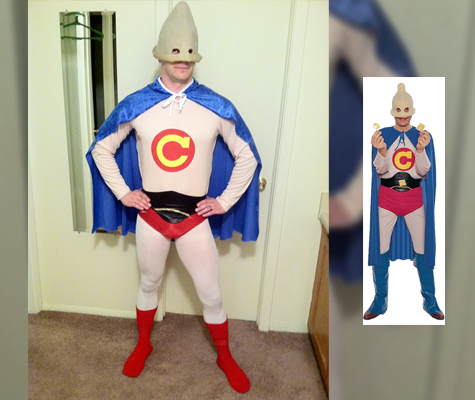
Captain Condom: I can't believe I get to wear this to work!

Tomorrow night is our first late-night program of the year. To help raise awareness about sexual health, and our Condom Sense program, I will be interacting with hundreds of students while dressed like this...

captain condom costume

The top, belt, and cape are from an out-of-the-bag costume that is sold in most Halloween stores, and usually seasonally in Walmart. These pre-packaged costumes never look as good as they do in the picture (the hat is very cheap).

At some point, I think we lost the pants - which is kind of a big deal. I decided to get some snazzy white tights and red football socks covering slippers. The red Speedo is mine, from my undergrad diving career.

I hope the costume gets a big reaction out of the students! I think it will be a memorable way for people to learn about condoms - and hopefully I can pose for some photos at the event!

A little sod fixes anything: Cutting it kinda close!

sod in front of the residence hall
Photo by Skyler Rogers

Students move into our new residence halls TOMORROW morning, and the sod is going in today. Talk about cutting it close! The new grass brings everything together - the building wouldn't look "finished" without it.

While the landscaping is looking good, we are still scrambling behind the scenes to get ready for our Late Night @ the REC event tomorrow night from 10pm to 1am. Today we picked up about 40 cases of soda and water, and I'm going back into the building after hours to assemble the rear-projection screen for the Xbox Kinect (that we have written permission to use).

After that, the only thing left to do will be to finish my Captain Condom costume. We already have the generic costume store version of "captain condom" but somehow lost the pants over the years. If any costume could get away with no pants, I think Captain Condom would be a candidate! But, for the sake of our dress code, I bought different colors of tights and soccer socks to see which combination looks best.

Yeah, I take my Wellness Cosplay seriously! I'm sure I'll blog about it later.

Sunday, August 14, 2011

Student Athletes in Transition: Avoiding Post-Retirement Identity Difficulties

student athletes in transition avoiding post-retirement identity difficultues

This post can either be used as a handout or an outline for a presentation on the topic of avoiding post-retirement identity difficulties during student athlete transitions. (It wasn't intended to be an academic paper, which is why my citations are very brief and not properly formatted).

I created this handout while I was in the M.S. Sport Behavior and Performance program at Miami University in Oxford, Ohio. At the time, I was recognizing signs of post-retirement identify difficulties in myself, and researching this topic really helped me grasp what I was going through.

Personal Description Activity

Activity: Describe yourself in a list of 25 things. You only have a few minutes so write the first things that come to mind.

**AFTER COMPLETION OF ACTIVITY**:

After you have completed the activity, look at the first 5 items. Although you were not instructed to list the items in order of importance, the items you listed first are most likely the ones that you consider the most important or descriptive—because they were easiest to come up with. Example: you probably won’t see “I like apples” in the #1 spot, but “I’m a football player” seems more important to list first.

What is Identity?

Identity is defined as a multidimensional view of oneself that is enduring and dynamic, which means our identity is both stable and changing at the same time. How can this be? How we view ourselves is made up of a number of dimensions (like the things you listed in the activity), that have a fairly stable order of importance. However, the importance of each item can also be affected by other factors.

Stable and Changing: Think of your identity at practice, the most important dimension at that time is probably your role as an athlete. However, when you are taking an exam, your most important role is (or should be) your identity as a student. Both of these smaller parts make up how you view yourself as a whole—your identity.

Identity Narrowing

When one dimension of your identity takes priority over the others for a long period of time, it can become dominant or preferred. This can happen when the dominant dimension (athletic identity for example) takes control in other daily situations. Where you live, when you eat, when you sleep, who your friends are—pieces of who you are that become associated with athletics can make your athlete identity dominant.

Identity Narrowing can be a good thing because it helps strengthen the dominant identity which can lead to increased motivation and focus, a more appropriate schedule for daily activities, improved goal setting, and group cohesion on an athletic team.

On the other hand, think of investing in the dominant identity as putting all your eggs in one basket. Focusing on your identity as an athlete can help you during sports, but it may be athletes who identify strongly with the athlete role in particular who experience post-retirement identity difficulties.

What are Post-Retirement Identity Difficulties?

Post-Retirement Identity Difficulties are problems that arise after a transition (in this case retirement from competitive athletics) because of the loss of a major portion of identity. This loss may be expressed as an emotional, cognitive, or behavioral change.


Identify Difficulties Following a Transition

Emotional Cognitive Behavioral
Depression Unable to focus Alcohol or drug abuse
Feeling anxious Unable to make decisions Anti-social behavior
Feeling isolated Denial Eating disorders
Frustration Loss of confidence Trouble sleeping
Anger
Can't seem to get things done


Pearson and Petitpas (1990) predicted that transitions would be more difficult for athletes who:

  • exclusively based identity on athletics.
  • have a gap between level of aspiration and ability.
  • are inexperienced with transitions.
  • have limited ability to adapt due to emotional or behavioral deficits.
  • lack supportive relationships.
  • lack resources to cope with the transition.

This means that athletes with an exclusively dominant athletic identity, who are inexperienced with making decisions during a transition, and lack support or resources either from friends or members of the athletic department, may show more signs of difficulty adapting to their transition out of athletics.

The transition is also more difficult for athletes forced to retire early, or when the decision is out of their control—such as when the athlete is cut from the team, injured, or is ineligible. These transitions are usually more abrupt and leave the athlete less time to progress through the stages of transition.

Stages of Transition

Every athlete goes through the retirement transition after the completion of their athletic career—it is a time marked by a significant decrease in the amount of time spent competing in a particular sport, a decrease in the level of competition, or a time when the athlete stops being an athlete all-together.

Hopson and Adams’s (1977) process model addresses emotional and self-esteem reactions that go along with the transition. Stages can be thought of as a downward spiral followed by an upward climb in self-esteem and emotional reactions.

Each stage is marked by an emotional task that must be completed before moving on to the next level.

Emotional Tasks (Hopson and Adams, 1977)

Stage
Name
Description
Emotional response
1
Shock and Immobilization
End of career, involuntary transitions are more disruptive.
Feeling overwhelmed or shocked

2
Minimization and Denial
Desire to make the transition feel less important or deny the truth to minimize negative feelings.

Frustration, depression, anxiety, denial
3
Self-Doubt / Depression
Former athlete will begin to doubt their ability to provide for themselves.

Sadness, fear of the future, anger, loss of self-esteem
4
Letting Go
Individual reaches a critical point of acceptance of the event and begins to look to the future.

Let go of negative emotions, begin upward climb
5
Testing Options
A time to explore new options. A burst of energy and adopt a new way of looking at things.

A sense of moving forward, excitement and exploration
6
Search for Meaning
Reflect on the “rollercoaster of emotions” in the previous stages. Active participation in changing thoughts, behaviors, feelings.

Make sense of what has happened and attach new meaning to their experiences.
7
Internalization
Integration and renewal, exploration brings new ways of behaving and thinking.
Individuals are well adjusted and have learned new skills for coping with future transitions


Take-Away Message

The more you know about the retirement transition from competitive athletics, the more prepared you will be to face the emotional, cognitive, and behavioral challenges. Here are some additional tips for dealing with the transition:

Become a Life-Long Athlete – Just because you are no longer competing for your college team doesn’t mean you have to stop playing sports all together. Participating in a club or community sports program is a great way to stay healthy and to meet people with similar interests.

Know your Support Network – No one is planning on having a difficult transition, but just incase it’s tougher than you thought—know who you can go to for guidance: coaches, peers, counselors, academic coordinators, career development personnel.

Transferable Skills – Apply your competitive identity to other aspects of your life such as your career or job search. You’ve learned a lot more from playing sports than just the game itself.

Saturday, August 13, 2011

Ideas for an alcohol talk with a college athletic team during Fall Semester

alcohol talk for athletes

I was recently asked for some ideas for a pre-season alcohol / responsibility talk with an intercollegiate athletic team. I thought I'd share what I wrote in that email with the interwebs in case someone out there is looking for that same information...

For a talk with a college athletic team, I would emphasize how they should watch out for each other like a family. They should also respect each other if they choose not to drink. A divided team runs the risk of splitting social activities into the group of drinkers and group of non-drinkers.

Also, emphasize how the seniors and captains should be role models. On teams with a drinking culture, the seniors and captains usually drink the MOST which is counter-intuitive - but this also shows how they have the ability to influence team behavior. Even if members choose to drink during the season, see if they are willing to have weekly alcohol-free activities (like Movie Night every Friday). This will not only increase their bonding and communication, but will at least take one night of drinking out of the equation.

Tell them how long alcohol can stay in their system the day after drinking, and can have a huge impact on their muscle recovery - so every time they drink after a workout, they are throwing away hours in the gym or on the field! Paint the picture that excessive drinking is what teams do when they aren't serious about their sport. Challenge them to rise above what the typical college social scene might include, because they aren't typical college students. They have elite status, they are here for a reason, and they are better than that.

The easiest way to change drinking habits is to not develop them in the first place, so they should start in with alcohol-free group activities right away when the school year starts. Individual choices become the team's business, especially on team sports. They should get on each others' cases about things they are not OK with, and it shouldn't be the coach's job to regulate their choices. The team is a family and a machine that only works as well as its weakest member.

This is the kind of stuff I would talk about, hope this helps! Go ahead and challenge them. They are likely competitive individuals, and will be very optimistic about taking the sport seriously right at the start of the year - so try to sustain that optimism!

Drunk support is a new twist on bystander intervention for alcohol prevention

party lifeguard at a college drinking party

I just finished reading the article "Drunk Support" on Inside Higher Ed, and I was intrigued by this new term and its implications for tweaking our existing alcohol prevention programs. The term "drunk support" was coined by Thomas Vander Ven, an Ohio University associate professor of sociology, and refers to the social aspect of the college drinking scene in which students might coerce each other to drink more in one instance, and later offer help or assistance in the form of water, an escort home, or even emergency assistance.

I haven't read Mr. Vander Ven's book, but from the description in the article it sounds like this is a silver lining to drinking circles with strong social influences. On one hand, they might be egging each other on, and on the other they are more willing or likely to assist during a crisis.

I might have to pick up a copy of the book so I don't continue putting words in his mouth, but I'll continue this post for the sake of finishing my thoughts.

The article continues by describing a variety of bystander intervention programs that seem to be quite effective beyond the traditional social norming or educational poster campaigns that are more commonplace. The programs listed include the Red Watch Band program, the Quaker Bouncers, and the Green Team.

The Haverford Quaker Bouncers, in addition to being trained in bystander intervention techniques, are actually paid $10.25 an hour to monitor parties in teams of two. Likewise, Dartmouth's Green Team members are paid $44.00 per night to monitor parties.

This is a fairly bold move, and hey if you've got the funding why not give it a try! My only concern would be intentionally placing students at parties they wouldn't otherwise attend. Maybe I'm just being overly cautious, but training students to be more safety-consious in their everyday life is one thing. But having them attend raucous parties as paid lifeguards seems risky somehow. I suppose since they're the sober ones, they have less to worry about.

The quotes in the article were very positive, and anecdotes in the comments were also very telling. It sounds like students understand that these party monitors are not paid snitches, and are there for their benefit.

Jeff Millman, the creator of both the Quaker Bouncers and Green Team, is now president of his own start-up company SOTEER that "creates and supports a professionally-trained, non-threatening peer monitoring system for parties and acts as a liaison between students and college administrators" (source).

Thursday, August 11, 2011

Drinking culture Prezi presentation for RA Diversity Day adds some unexpected wellness

Drinking culture and the beliefs your students bring to campus

On Wednesday, I presented a Prezi titled Drinking Culture and the Beliefs Your Students Bring to Campus to a group of RA's for RA Diversity Day. I know, normally we don't get to sneak alcohol education into diversity training - but this went over rather well! The entire thing took an hour and 15 minutes. I took the lead, and was followed with sections presented by our Drug and Alcohol Prevention Specialist at the Counseling Center, and our Director of Wellness.

I started with a hook: Some interesting alcohol facts about traditional beverages from Egypt and Kenya. I got my information from the 2004 WHO report on alcohol, which is quite a hefty document!

I talked about different minimum drinking ages in different countries, which led into a discussion of countries where alcohol is forbidden (for citizens) with a reference to Sharia customs. I think this religious component was really interesting, and mirrored it later by talking about the Mormon "Word of Wisdom" which also explicitly prohibits alcohol.

The quilt activity in the middle was probably the RAs' favorite part. We had them each draw pictures or words that represent the direct and indirect influences of their own family or community. We had some pretty creative quilt squares! The students really enjoyed sharing with each other, which drove home the point that everyone brings different experiences and influences with them to campus.

Drinking culture and the beliefs your students bring to campus

It took me forever to find vector world maps to use on Prezi. Then I found out Prezi supplies a vector world map template presentation that was way better than the maps I found, and I felt silly. So make life easy, and just re-use the Vector Maps in Prezi template.

What I learned: Don't reinvent the wheel, especially when the wheel is a vector map.

The checkout is the last checkpoint [comic]

Since my post about Finish Line supplying ping pong balls for "Shoe Pong," I was made aware of a display of College Essentials in Target, and I've been thinking more about the role of the cashier as the last arbiter leading up to risky decisions (especially risky decisions involving large quantities of alcohol and alcohol, um, accessories).

It reminded me of teenagers buying large amounts of toilet paper and eggs, and the cashier all but calling their parents in an attempt to stop them. Why is there not a similar protest in an attempt to avoid potentially destructive situations later in life?

cashier at checkout with student buying beer or toilet paper

I labeled this post [comic] because I'm thinking about making more of these Photoshop college collages. Ooooh, zippy!

Tuesday, August 9, 2011

Reasons to prohibit concealed weapons on college campuses

college guns campus carry

In response to the article Activists and Politicians Discuss the Right to Carry Concealed Weapons on College Campuses posted on The Chronicle, I thought I would summarize the top reasons for prohibiting concealed campus carry.

First, it is important to dispel some of the straw-man arguments that typically get shot down by the pro-carry side (pun intended?). The straw-man arguments are flimsy, easily-rebutted arguments that are brought up for the purpose of being defeated during one-sided debates.

Typical straw-man rebuttals include "Not all students who carry guns are killers" and "Guns don't kill people, people kill people." These might be great points, but nobody was arguing that all students who carry guns are killers, and nobody was trying to convince you that guns alone kill people. So let's focus on the arguments the anti-carry side ARE making...

1.) Concealed weapons would detract from a healthy learning environment. Some students and faculty are likely to feel less safe on a campus with concealed weapons. Surely, many students already feel unsafe on college campuses, especially members of minority groups - so when the uneasiness of being a minority is compounded by the fact that anybody could be carrying a concealed handgun, the anxiety would increase. Students experiencing anxiety on a daily basis would suffer academically. This is a fact that is often overlooked by majority students who do not understand what it feels like to experience a small but constant social pressure.

2.) Concealed weapons would introduce more weapons to a college campus. In the rare event that students have a physical altercation, their options are typically limited to fights with whatever items they have on them - including books, backpacks, fists, shoes, etc. Introducing guns to the equation means that there are more (serious) options. Even if the owner of the gun does not intend to use it, the gun could be stolen, taken, dropped, or simply used to threaten. A counter argument to this is that students who are planning on getting into serious fights might already be carrying concealed weapons illegally.

3.) One of the most important anti-carry arguments comes from law enforcement, and states that having multiple gun carriers on campus might create situations with multiple shooters. In a hypothetical situation with a campus shooter, if other students drew their concealed weapons, it would make it extremely difficult for responding officers to know who poses a serious threat. This would increase the difficulty and response time for the officers to do their jobs.

Finally, I'll end with a counter argument to the pro-carry sentiment that carrying a concealed weapon somehow protects the carrier. In the event of a shooter, the pro-carry side envisions a student with a concealed weapon protecting him or herself with return fire. There are two major implications here: (1) If students are seeking to return fire, they're not doing the most important thing, which is getting the heck out of there! (2) It is impossible to anticipate the emotional state you will be in. From the article in The Chronicle, Colin Goddard said that "when the gunman burst into his classroom, shock prevented him from seeing the situation clearly." Shock could also prevent someone with a concealed weapon from responding appropriately.

The idea that a person with a concealed weapon is protecting themselves by returning fire is crazy to me! How could firing even more bullets on a college campus be doing any good? Guns don't kill people, but bullets flying through campus from an undefined number of reactive, untrained shooters might.

If you want even more reasons, check out Why Our Campuses are Safer Without Concealed Handguns.

In the end, it's difficult to say what the best policy is in terms of concealed carry. There are so few campuses that allow concealed carry, and dramatic shooter events are (fortunately) very rare, that we just don't have the data to back up many of the implications. We should be able to discuss the topic rationally, without resorting to ad hominem attacks on students who wish to carry concealed weapons, and without invoking easily defeated straw-man arguments.

What I learned: Pro-carry legislators have an uphill battle, but "the way things have always been" arguments don't hold up to scrutiny.

Saturday, July 30, 2011

Printable before and after Photoshop photos from magazines for Body Image presentation

Printable before and after Photoshop photos from magazines for Body Image presentation

Last week, I gave a presentation on alcohol awareness and body image to a group of 16-17 year old girls. I wanted to find some visuals to bring with me to prove how much Photoshop work is done to cover models, and that this ideal level of beauty is unattainable (even for the models themselves).

To save you some time, I've included the full size images in this post, so you can print them out and use them for your own educational presentations.

First up, we have a cover model for Nitro Magazine. This is one of the best examples of before-and-after Photoshop images I was able to find, and luckily they are high enough resolution to be printed as a full page image. Click on the images to download the high-res versions.

Printable before and after Photoshop photos from magazines for Body Image presentationPrintable before and after Photoshop photos from magazines for Body Image presentation

When I showed these images to the group, I started with the after after photo, and then showed them the before photo. Their reaction was interesting, I heard "ewww she's ugly" and "she's sooooo old!" I challenged this viewpoint and said she's only old and ugly compared to this painting of herself - this is how she really looks. This is how normal people look.

Nichkhun photoshop abs mistakeNext, I showed the group that not only women are Photoshopped in magazines. I found this great image of model "Nichkhun" where the editors went a little overboard on his abs, resulting in the loss of his belly-button.


The point here is not that removing his belly-button makes him more attractive (it doesn't), but that the editors were so Photoshop-crazy that they just glossed right over it!


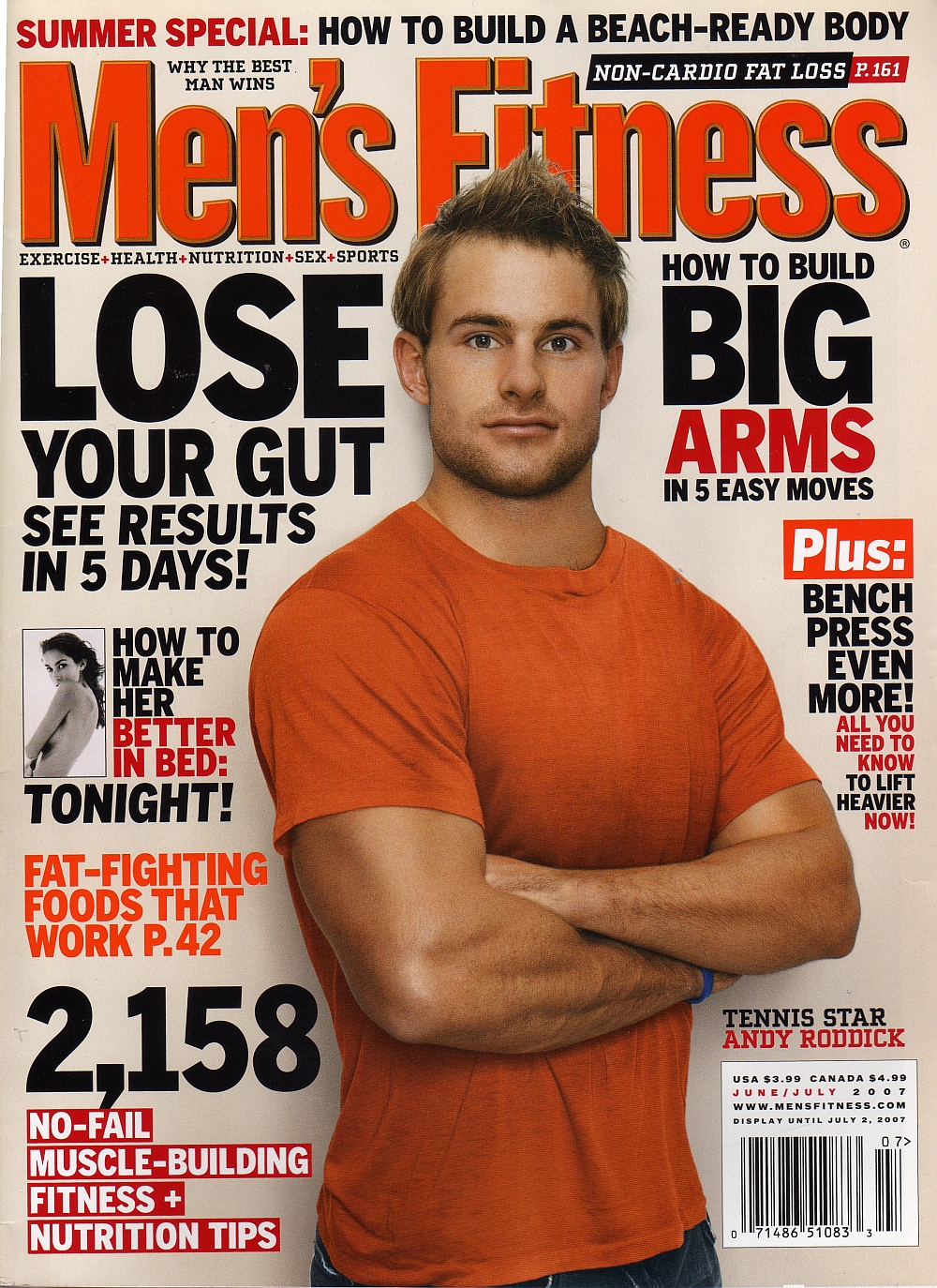
Finally, here is another Photoshop-failure classic. It's Men's Fitness magazine with Andy Roddick on the cover. Andy was so shocked by the final cover, that he didn't even recognize himself.
"Little did I know I have 22-inch guns and a disappearing birth mark on my right arm. I saw the cover for the first time when I landed after Rome [tournament]. It was pretty funny.
"I walked by the newsstand in the airport and did a total double take. I can barely figure out how to work the red-eye tool on my digital camera. Whoever did this has mad skills" (source).
I don't have the original image of the cover, but there is an obvious difference in the size of his arms compared to this "normal" photo of Andy playing tennis.

andy roddick Printable before and after Photoshop photos from magazines for Body Image presentationandy roddick Printable before and after Photoshop photos from magazines for Body Image presentation

What I learned: A picture is worth a thousand words.